
Before Software, Private Credit's Problem Child was Energy
A history lesson courtesy of Apollo

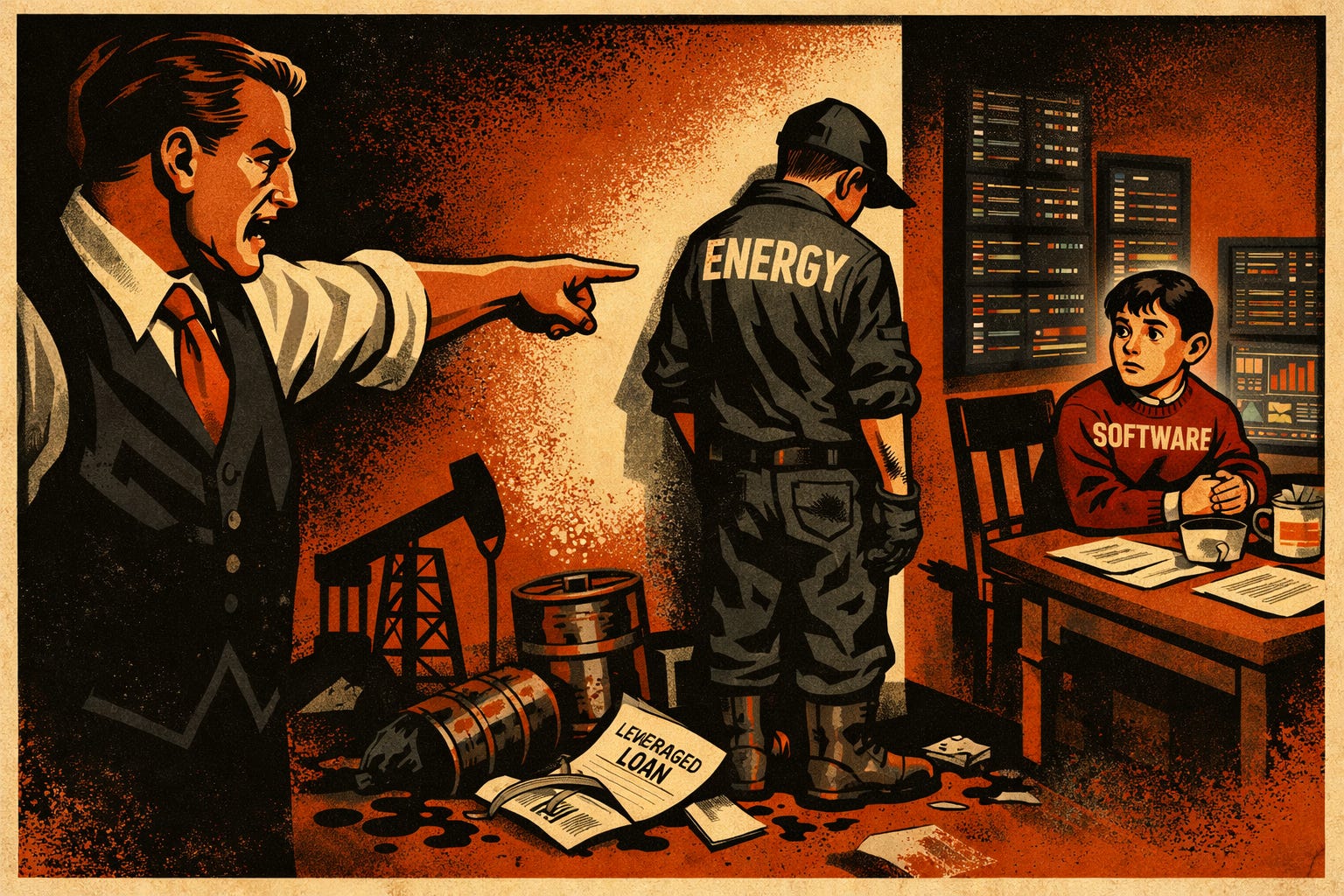
The Head of Risk at my firm likes to remind our team that there are 3 things that kill investment funds: leverage, illiquidity and concentration.
Of the three, concentration is the one private credit is most anxious about right now. Specifically, concentration in software loans.
Octus estimates that software companies represented roughly 29% of BDC investment cost and fair value as of September 30, 2025. On its own, that would not necessarily be a bad thing.
Software has long looked like an attractive lending sector: high-margin businesses, recurring revenue, sticky customers, and contract structures that make cash flows seem durable.
But AI has begun to unsettle many of these assumptions. Equity investors are beginning to question the stickiness and durability of the average SAAS contract in the age of ChatGPT. And the implications for software exit values if churn begins to increase.
In turn, private credit firms with above-average software exposures are beginning to sweat over their ability to refinance their loans in the not-so-distant future. A loan made at 50% LTV to a software company quickly becomes 100% LTV if the EBITDA multiple falls by half.
While the anxiety is concentrated on software today, private credit has seen this movie before.
Back in 2015, the area of concern was energy. Like software companies in the 2020s, energy companies were prolific users of leveraged finance (high yield, leveraged loans, and private credit) in the 2010s.
During the shale boom, U.S. energy companies massively increased their borrowing to fuel their drilling activities. In U.S. high yield, energy issuance totaled about $290 billion from 2008 to 2014, according to J.P. Morgan data, and the sector’s weight in the high-yield index climbed from 10% to nearly 15% by 2014.
Much of that borrowing came from smaller shale producers funding expansion despite weak free cash flow.
The energy story cracked when oil prices collapsed in 2014 and OPEC chose not to cut production at its November meeting, signaling that it would tolerate lower prices rather than keep supporting the market on its own.
For upstream borrowers, that meant the stress showed up quickly in cash flows. Revenue moved with the commodity, and a sector that had borrowed heavily suddenly had to operate against a much lower price deck.
All of a sudden, credits that had looked sound began to unravel as interest coverage ratios plunged.
Amongst private credit lenders, Apollo’s BDC, Apollo Investment Corporation (Ticker: AINV), was hit hardest given their outsized exposure to the sector at the time.
As of June 30, 2015, AINV reported that oil and gas represented 17.0% of its portfolio at fair value (the highest or second-highest amongst large BDCs as of that date, depending on the data source).
This makes AINV a useful case study for what plays out when a credit vehicle makes a sizeable sector bet and has to unwind it. I wanted to explore this in some detail to see if there are lessons to be drawn for software’s current predicament.
Before software, private credit had shale
When the build out of the shale patch was in full swing in the 2010s, one of the most vocal supporters was Apollo. At the firm level, Apollo described energy in 2014 as one of its “favorite spots” (Link) and “one of the few arbitrage opportunities in overvalued markets” (Link).
They backed this conviction with their lending activities. Their BDC, AINV, grew Oil & Gas exposure as a percentage of their portfolio from 0% in early 2012 to a peak of 17% in June 2015.
Things were fine for a few years. They earned extra spread lending to energy firms, which could afford the high interest with oil prices near $100.
But things started to unravel in the second half of 2014. Oil prices, as benchmarked by West Texas Intermediate (“WTI”) crude, fell from roughly $98 a barrel on June 30, 2014 to about $48 by December 31, 2014.
Apollo’s decision to lean into energy lending when they did looked like a mistake. But they were stuck in the loans.
Losses didn’t immediately occur. Instead, the stress slowly metastasized across the book.
The first sign was the increase in Payment-in-Kind (“PIK”) payments as a percentage of income. PIK payments are effectively interest deferral, where a company short on cash will add the amount of the interest payment to principal.
PIK payments began to rise materially after September 2014, before peaking in December 2015 at 16.2% of income.
Non-accruals and net realized losses (“NRLs”) took longer to show up in the book given BDC accounting rules that allow firms to delay moving a loan to non-accrual until the company believes that PIK is no longer expected to be realized.
BDCs are incentivized to delay reporting non-accruals or NRLs because doing so reduces their NAV, which in turn reduce the fees they can charge. It may also reduce their ability to borrow.
Only when the gap between the original underwriting case and actual cash generation becomes too wide does a lender flip a loan into non-accrual, before, ultimately, deciding to take a loss.
You can see this play out at AINV, where PIK % peaked in December 2015 → Non-Accrual % peaked in June 2016 → and Net Realized Loss % peaked in June 2017.
Even before marks started hitting the portfolio in earnest, the market began to price down AINV’s portfolio. The BDC traded down from 0.99x NAV, prior to the energy selloff, to a low of 0.59x (a 41% discount-to-NAV) on March 31, 2016.
Despite the selloff in their BDC, and stress on their portfolio, management remained confident in the credit quality of their portfolio for much of 2014 and in to 2015. In Apollo’s Q3 2014 earnings call, Co-Founder Josh Harris said Apollo was “tactically working to take advantage of the market dislocation” and still saw it as an opportune time to buy physical assets at a discount to financial-market valuations.
Sentiment in the MD&A section of their filings reflects this, before cracking in early 2015.
By the 2016 annual report, the tone had clearly changed. AINV was now emphasizing that results had been “negatively impacted” by oil and gas and talking about reducing exposure through “attractive monetizations” while being “proactive” about restructurings and future funding needs.
During that fiscal year, the company said it had monetized $85 million, or 18%, of its oil and gas portfolio, and explicitly grouped oil and gas with “remaining legacy investments”, implying that oil and gas loans were no longer a new origination focus of the firm.
Personnel changes that same year reinforced the point that a change in philosophy was occurring at the BDC. In June 2016, Apollo announced that Howard Widra would replace Ted Goldthorpe as President, that Goldthorpe would step down from his CIO role at the adviser, that Tanner Powell would become CIO, and that Patrick Ryan would formally take the title of Chief Credit Officer.
Apollo did not explicitly say this was a response to energy losses. But the sequencing suggests that it was: as the book’s problems became harder to frame as temporary volatility, Apollo also moved to change the people overseeing it.
With companies in their energy book starting to miss payments, Net Interest Income (“NII”) per share began to decline. AINV defended the payout through the first half of 2016, letting dividend coverage tighten, before resetting the dividend in 3Q 2016 to something the post-damage earnings base could support.
By 2019, the worst of the energy damage had passed. Apollo gradually remade the BDC into something much less cyclical. The old AINV did not disappear overnight, but over time it became less of an oil and gas cleanup story and more of a middle-market direct lending vehicle tied to Apollo’s MidCap Financial platform.
The symbolic break came on August 1, 2022, when Apollo Investment Corporation changed its name to MidCap Financial Investment Corporation, and on August 12, 2022, when the ticker changed from AINV to MFIC.
The rebrand was more than cosmetic. It signaled that Apollo wanted the market to value the company less as a legacy BDC with a history of energy losses and more as a scaled first-lien lender plugged into MidCap’s origination engine.
There was a cost to getting there. By March 31, 2022, just before the rebrand, Apollo Investment’s portfolio at fair value had fallen to roughly $2.52 billion, down from about $3.35 billion at March 31, 2015.
In that sense, the BDC did recover, but it first had to become a smaller, cleaner, more conservative vehicle.
The business eventually rebuilt book value, but only after years of write-downs, dividend resets, and portfolio rotation had already forced the old strategy out of the system.
AINV’s energy exposure did not kill Apollo, but it did force a reset. The BDC that exists today is larger and healthier than the post-energy version, but it is also plainer, safer, and much more explicitly aligned with Apollo’s MidCap lending franchise.
Lessons for Today
So, what are the lessons for the current moment in private credit?
Like energy in the 2010s, software is a large concentration for BDCs in the 2020s. But there are some notable differences in terms of how the exposure might ripple through portfolios.
The biggest difference between software now and energy then is the speed of the cash flow shock. In energy, the stress was immediate. Oil prices collapsed in the second half of 2014, OPEC chose not to cut production in November, and upstream borrowers saw the pain move directly through revenue and coverage ratios.
Many smaller U.S. oil companies, including shale firms, had already borrowed heavily to expand production capacity even as capital expenditures exceeded cash flows by wide margins.
Software is different. The near-term risk is not that current period revenue suddenly drops like it did for drillers at $50 oil. It is that pressure shows up later, at contract renewal and in the refinancing market, where lower growth, weaker pricing power, and lower enterprise value multiples may all converge at once.
Like we saw with AINV, weakness for software borrowers likely first shows up in elevated PIK payments. Average software loan PIK is already high at 12.8% per Octus.
But, importantly, most software PIK was negotiated at origination, not added later through amendments (the worse kind of PIK and what we saw at AINV).
As a result, it is tough to get a read on exactly what PIK is telling us just yet. But this number should be watched very closely.
At AINV, rising PIK showed up before non-accruals, and non-accruals showed up before realized losses. The accounting moved before the final outcome did.
If software follows a similar pattern, the real credit event likely doesn’t begin with a wave of defaults. It may begin with more subtle signs like weaker marks, growing investor skepticism, tougher amendments, slower exits, and a refinancing market that no longer supports yesterday’s LTV assumptions.
The lesson from Apollo and AINV is not that software is energy—or that every concentrated sector bet ends in disaster. But that a sector can be so large, so financeable, and so easy to defend that lenders stop thinking of concentration as risk and start defending it as expertise.
That feeling can persist for a long time, especially in an illiquid market where marks move slowly and the maturity wall seems far away.
But when the refinancing math finally changes, concentration stops looking like a sign of edge or expertise and starts looking like a key weakness.
Covenant Lite
This article is for informational and educational purposes only and reflects my opinions as of the publication date. It is not investment advice, legal advice, tax advice, or a recommendation to buy or sell any security. I may hold positions in securities discussed, and my views may change without notice. Readers should do their own work and consult their own advisors before making investment decisions.
Great read, as always! The irony is that back in 2015, KKR’s global head of energy and infrastructure had a couple of deals blow up. It was Marc Lipschultz, who later left and co-founded Blue Owl, which now sits at the epicenter of SaaS lending.
Great article and recount of history The conclusions are very sensible and not unexpected.